
Yes, you can dunk at 5’10”. Your height does not automatically prevent you from dunking a basketball.
At 5’10”, you will generally need a strong vertical jump because your standing reach is likely lower than that of a taller player. However, standing reach varies from person to person, so height alone cannot tell you exactly how much vertical you need.
The more useful question is not simply “can you dunk at 5’10?” but rather:
How high is your standing reach, and how much vertical jump can you produce?
Once you know those numbers, you can calculate a much more realistic dunking target.
Can a 5’10 Person Dunk?
Yes, a 5’10 person can dunk.
There are basketball players around this height and below who have developed enough jumping ability to dunk. The challenge is that a shorter player usually has to make up for a lower standing reach with a higher vertical jump.
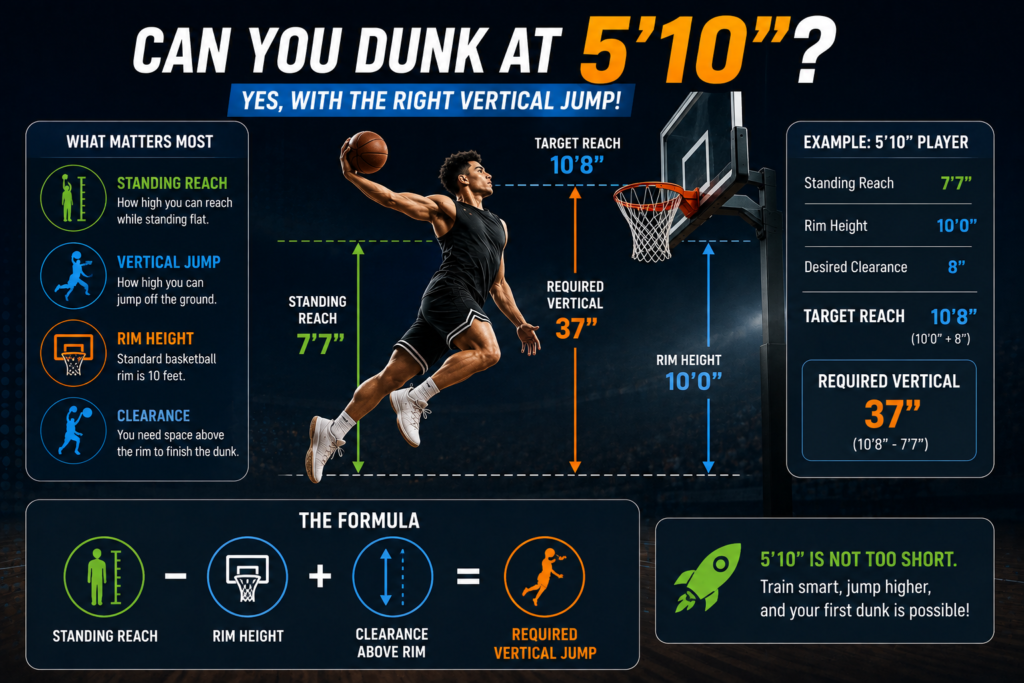
For example, imagine a 5’10” player has a standing reach of approximately 7’7″. If the target reach is 10’8″, the calculation would be:
10’8″ − 7’7″ = 37 inches
In this example, the player would need an estimated 37-inch vertical jump to reach that target.
This is only an example. Your actual standing reach could be higher or lower, which would change the required vertical.
Why Standing Reach Matters More Than Height
Height is useful for describing a player’s size, but it is not the best measurement for calculating how high they need to jump.
Standing reach measures how high you can reach with one hand while standing flat-footed. It takes your arm length and overall proportions into account.
Two players who are both 5’10” can have different standing reaches. One might have a longer wingspan and higher standing reach, while another might have a shorter reach.
The player with the higher standing reach will generally need less vertical jump to reach the same target.
This is why a good dunk calculation should use your actual standing reach, rather than simply estimating your required vertical from your height.
How Much Vertical Does a 5’10” Player Need to Dunk?
There is no single vertical jump number that applies to every 5’10” player.
Your required vertical depends on:
- Standing reach
- Rim height
- Desired clearance
- Jumping technique
- Takeoff style
- Ability to control the basketball
A standard basketball rim is 10 feet high. However, reaching the rim is not necessarily enough to complete a dunk. You generally need additional reach above the rim to control the ball and finish.
For example, consider a player with a 7’7″ standing reach and an 8-inch clearance target.
The target reach would be:
10’0″ + 8″ = 10’8″
Then:
10’8″ − 7’7″ = 37″
The estimated required vertical would therefore be 37 inches.
Another 5’10” player with a 7’9″ standing reach would need:
10’8″ − 7’9″ = 35″
That two-inch difference shows why your individual measurements matter.
How to Find Your Required Vertical
If you are 5’10” and want to know whether you can dunk, start by measuring your standing reach.
To measure it:
- Stand next to a wall with your feet flat on the ground.
- Reach upward with one hand.
- Keep your heels on the floor.
- Mark the highest point of your fingertips.
- Measure from the floor to the mark.
Once you have your standing reach, you can calculate your target.
The basic formula is:
Required Vertical Jump = Target Reach − Standing Reach
For a more personalized calculation, use our Dunk Calculator to enter your standing reach, rim height, clearance, and current vertical.
Internal link recommendation: Link “Dunk Calculator” to your main calculator page. This is the strongest natural internal-link placement because the reader has just learned why their individual measurements matter.
You can also learn more about the calculation process in our The Dunk Calculator guide.
What If You Are Close but Cannot Dunk Yet?
Suppose your required vertical is 36 inches but your current vertical is 31 inches.
That means you have an estimated 5-inch gap between your current ability and your target.
Instead of thinking that you simply “cannot dunk,” treat the number as a measurable training goal.
You can track:
- Current vertical
- Rim touches
- Approach jump height
- Standing jump height
- Jump consistency
- Your ability to control the ball near the rim
Progress may not happen at the same rate every week. Strength, fatigue, technique, body weight, training experience, and recovery can all affect your jumping performance.
How Can a 5’10” Player Improve Their Dunking Ability?
If you are 5’10” and want to dunk, your training should focus on improving both force production and jumping technique.
Common areas of training include:
Lower-Body Strength
Exercises such as squats and split squats can help develop lower-body strength when performed with appropriate technique and progression.
Plyometric Training
Exercises such as box jumps, broad jumps, and other controlled jumping drills can help you practice explosive movement.
Approach Jumps
A running approach can allow you to use momentum when jumping. Practicing your approach and takeoff can therefore be useful for basketball-specific jumping.
Recovery
Hard jumping sessions place stress on your muscles and joints. Adequate rest, sleep, nutrition, and sensible training volume are important parts of a long-term training plan.
For a more detailed training guide, see our How to Dunk article, which covers exercises, jumping technique, approach work, and progressions toward your first dunk.
Does Being 5’10” Make Dunking Harder?
Being 5’10” can make dunking more challenging than it is for a much taller player because you may have a lower standing reach.
However, being shorter does not make dunking impossible.
The important factor is the combination of your standing reach and vertical jump.
Think of it this way:
Standing Reach + Vertical Jump = Maximum Reach
If your maximum reach is high enough to reach your target with sufficient clearance, your height by itself does not prevent you from dunking.
This is why a shorter player with an excellent vertical can dunk while a taller player with a relatively low vertical may struggle to finish above the rim.
Can a 5’10” Player Dunk in a Game?
Yes, but game dunking can be more difficult than dunking in a controlled practice environment.
During a game, you may have to jump after sprinting, reacting to a defender, changing direction, or handling the ball. Fatigue can also affect your jumping ability.
A player who can barely reach the required height in practice may find it harder to complete the same movement during a competitive game.
Developing a comfortable margin above your minimum target can therefore make actual game dunking more realistic.
Final Answer: Can You Dunk at 5’10”?
Yes, you can dunk at 5’10”.
The exact vertical you need depends on your standing reach, target clearance, and jumping technique. There is no universal vertical requirement for every 5’10” player.
Rather than comparing yourself with another athlete, measure your own standing reach and current vertical. Then calculate the difference between your current ability and your target.
If you want to know your personal number, use the Dunk Calculator to estimate the vertical jump you need based on your measurements.
Once you know the target, you can build your training around closing that gap and improving your jumping ability over time.