
Dunk Calculator – Calculate the Vertical Jump You Need to Dunk
Find out how much vertical jump you need to dunk a basketball. Enter your height, standing reach, rim height, and desired clearance to calculate your required vertical jump instantly.
What Is a Dunk Calculator?
A dunk calculator is an online tool that helps basketball players estimate how high they need to jump to dunk a basketball. Instead of guessing whether you can dunk based only on your height, the calculator uses your standing reach, rim height, and required clearance to estimate the vertical jump you need.
Your height can give you a general idea of your dunking potential, but your standing reach is especially important because it shows how high you can reach while standing on the ground. Two players with the same height can have different standing reaches and may therefore need different vertical jumps to dunk.
The dunk calculator makes this calculation simple. Enter your measurements, choose your rim height and clearance, and the tool calculates the approximate vertical jump required to reach your dunking target.
Whether you are working toward your first dunk, trying to improve your vertical jump, or tracking your basketball training progress, a dunk calculator can help you set a more realistic goal.
How the Dunk Calculator Works
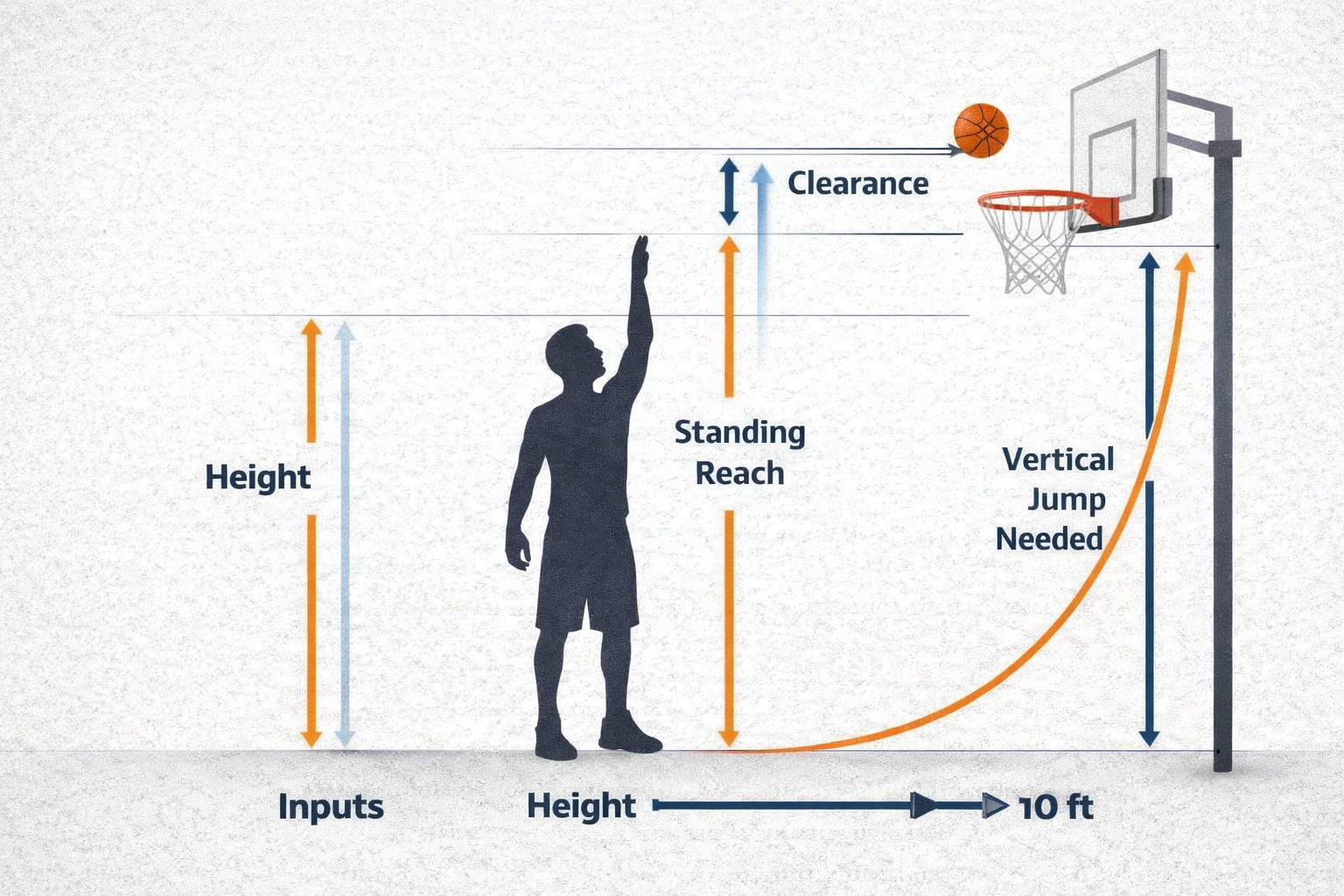
The dunk calculator uses a few key measurements to estimate the vertical jump required to dunk. These include your height, standing reach, rim height, and the amount of clearance you want above the rim.
Here is how it works:
- Enter your height.
- Enter your standing reach.
- Enter the rim height you want to dunk on.
- Add the amount of clearance you want above the rim.
- The calculator determines the approximate vertical jump required to reach that target.
The basic calculation is:
Required Vertical Jump = Target Reach − Standing Reach
Your target reach is based on the rim height plus the clearance you want above the rim.
For example, if the rim is 10 feet high and you want 8 inches of clearance, your target reach is 10 feet 8 inches. If your standing reach is 8 feet, you would need an estimated 32-inch vertical jump to reach that target.
This calculation gives you a useful starting point for understanding how much vertical jump you need to work toward.
How High Do You Need to Jump to Dunk?
There is no single vertical jump number that allows every basketball player to dunk.
The vertical jump you need depends on your standing reach and the height of the rim. A taller player with a longer standing reach may need less vertical jump than a shorter player to reach the same rim.
For a standard basketball rim, the rim height is 10 feet (120 inches). However, simply touching the rim is not the same as dunking. You generally need additional reach above the rim to control and finish the dunk.
For this reason, your standing reach is one of the most useful measurements when estimating your dunking ability.
Example Vertical Jump Estimates
The following examples show why standing reach matters:
| Standing Reach | Rim Height | Clearance | Required Vertical |
|---|---|---|---|
| 7’4″ | 10’0″ | 8″ | 40″ |
| 7’6″ | 10’0″ | 8″ | 38″ |
| 7’8″ | 10’0″ | 8″ | 36″ |
| 8’0″ | 10’0″ | 8″ | 32″ |
| 8’2″ | 10’0″ | 8″ | 30″ |
| 8’4″ | 10’0″ | 8″ | 28″ |
These are example calculations, not fixed requirements for every player. Your actual standing reach, jumping technique, takeoff style, hand size, and dunk technique can affect your ability to complete a dunk.
For a more personalized estimate, use your own standing reach and current vertical jump in the calculator above.
Why Standing Reach Matters for Dunking
Many players focus on height when thinking about dunking, but standing reach is often more useful for calculating your required vertical jump.
Standing reach is the highest point you can reach with one hand while standing flat-footed. Players of the same height can have different arm lengths and therefore different standing reaches.
For example, two players may both be 6 feet tall, but one player may have a longer standing reach than the other. The player with the higher standing reach would generally need less vertical jump to reach the same target.
This is why the dunk calculator asks for your standing reach instead of relying only on your height.
How to Measure Your Standing Reach
To measure your standing reach:
- Stand next to a wall with your feet flat on the floor.
- Reach as high as possible with one hand while keeping your heels on the ground.
- Mark the highest point you can reach.
- Measure from the floor to that mark.
- Enter the measurement into the dunk calculator.
For the most accurate result, measure your standing reach carefully instead of estimating it from your height.
How Much Clearance Do You Need to Dunk?
Clearance refers to how far above the rim you want your hand or the ball to reach.
The amount of clearance you need can vary depending on your dunk style, hand size, ball control, and technique. A player attempting a simple one-hand dunk may have different requirements from a player attempting a more difficult dunk.
The calculator allows you to enter a clearance value so you can adjust the calculation to your goal.
For example, with a 10-foot rim and 8 inches of clearance, the target reach is:
10 feet + 8 inches = 10 feet 8 inches
If your standing reach is 8 feet, the estimated required vertical is:
10’8″ − 8’0″ = 32 inches
You can change the clearance value in the calculator to see how your required vertical changes.
Why Basketball Players Use a Dunk Calculator
Basketball players at different skill levels can use a dunk calculator to set realistic jumping goals and understand their current dunking potential.
Dunking is not just about height. It also requires explosive power, jumping technique, coordination, timing, and the ability to control the basketball in the air.
Common reasons players use a dunk calculator include:
- Setting clear basketball training goals
- Finding the vertical jump required to dunk
- Tracking vertical jump improvements
- Understanding their current dunking potential
- Creating more focused strength and conditioning goals
- Comparing their current vertical with their target vertical
- Estimating how much additional vertical jump they may need
Knowing your target can make your training more measurable. Instead of simply trying to “jump higher,” you can work toward a specific vertical jump goal.
Benefits of Using an Online Dunk Calculator
Using a dunk calculator online makes it easier to estimate your required vertical jump without doing the calculations manually.
Some of the key benefits include:
- Fast vertical jump estimates
- Simple and easy-to-use calculations
- Personalized results based on your measurements
- Helps you set measurable jumping goals
- Useful for basketball players and athletes
- Works with different rim heights and clearance goals
- Can be used on a phone, tablet, or computer
Whether you are training at a basketball gym or working out at home, knowing your target vertical can help you better understand what you are working toward.
Example: Calculating Your Required Vertical Jump
Let’s say a player has a standing reach of 8 feet and wants to dunk on a standard 10-foot rim with 8 inches of clearance.
First, calculate the target reach:
10 feet + 8 inches = 10 feet 8 inches
The player’s standing reach is:
8 feet = 8 feet 0 inches
Now subtract the standing reach from the target reach:
10 feet 8 inches − 8 feet 0 inches = 32 inches
The player would therefore need an estimated 32-inch vertical jump to reach that target.
A dunk calculator performs this calculation instantly, making it easier to understand your target without doing the math yourself.
Keep in mind that this is an estimate. Actual dunking ability can also depend on jumping technique, approach, timing, ball control, and other athletic factors.
Can You Dunk With a 30-Inch Vertical?
A 30-inch vertical jump may be enough for some players to dunk, but it depends heavily on standing reach and dunking technique.
A player with a higher standing reach may be able to reach the required target with a 30-inch vertical, while another player may need a higher vertical jump.
That is why vertical jump should not be considered by itself. Enter your standing reach and target clearance into the dunk calculator to get a more personalized estimate.
How to Improve Your Vertical Jump for Dunking
If your calculated vertical jump is higher than your current vertical, you can use the difference as a training target.
Improving your vertical jump can involve several areas, including:
- Lower-body strength training
- Plyometric exercises
- Jump technique
- Explosive power development
- Sprint and acceleration work
- Mobility and flexibility
- Proper recovery and sleep
- Consistent basketball training
Your training should match your current fitness level and experience. Increasing your vertical jump takes time, so focus on gradual progress rather than expecting immediate results.
For a detailed training plan, see our guide on how to increase your vertical jump for dunking.