
Dunking a basketball is a goal for many players, but getting your first dunk takes more than simply trying to jump higher. You need enough vertical jump, good jumping technique, lower-body strength, coordination, and consistent practice.
If you are wondering how to dunk, the first step is understanding how much vertical you actually need. From there, you can build a training plan around improving your jumping ability and practicing the skills needed to finish a dunk.
Whether you are trying to touch the rim for the first time or working toward your first full dunk, this guide explains the basic steps that can help you get closer to your goal.
What Do You Need to Dunk?
Before starting dunk training, it helps to understand what actually determines whether you can dunk.
The main factors are:
- Standing reach
- Vertical jump
- Jumping technique
- Lower-body strength
- Explosive power
- Approach speed
- Coordination
- Ball control
Your height matters, but it is not the only factor.
Two players who are the same height can have different standing reaches and vertical jumps. Because of this, one player may be closer to dunking than the other.
A useful way to think about it is:
Standing Reach + Vertical Jump = Maximum Reach
You need enough maximum reach to get the ball above the rim and complete the dunk.
How High Do You Need to Jump to Dunk?
The vertical jump required to dunk depends on your standing reach and the height of the rim.
A standard basketball rim is 10 feet high. However, simply touching the rim does not necessarily mean you can dunk. You generally need additional reach above the rim to control the ball and finish the dunk.
For example, if your standing reach is 8 feet and your target reach is 10 feet 8 inches, you would need approximately a 32-inch vertical jump.
If you do not know your required vertical yet, use our Dunk Calculator to calculate your personal target based on your standing reach, rim height, and desired clearance.
Dunk Calculator to your main calculator page here. This is the best location because the reader is learning how much vertical they need and is ready to calculate their own number.
For more information about the numbers behind dunking, you can also read our The Dunk Calculator guide.
The Dunk Calculator to your previous supporting article. This should be a secondary contextual link, not the main CTA.
How Can I Dunk a Basketball?
If you want to learn how can I dunk a basketball, start by breaking the goal into smaller steps.
You do not need to begin by attempting a full dunk every day. First, work on your jumping ability and learn how to use your approach effectively.
A simple progression can look like this:
- Measure your standing reach.
- Find your current vertical jump.
- Calculate the vertical you need to dunk.
- Build lower-body strength.
- Improve explosive jumping ability.
- Practice your approach and takeoff.
- Start practicing with a smaller target or lower rim.
- Gradually work toward a full-height dunk.
This approach gives you measurable goals instead of simply repeating maximum-effort jumps without knowing whether you are making progress.
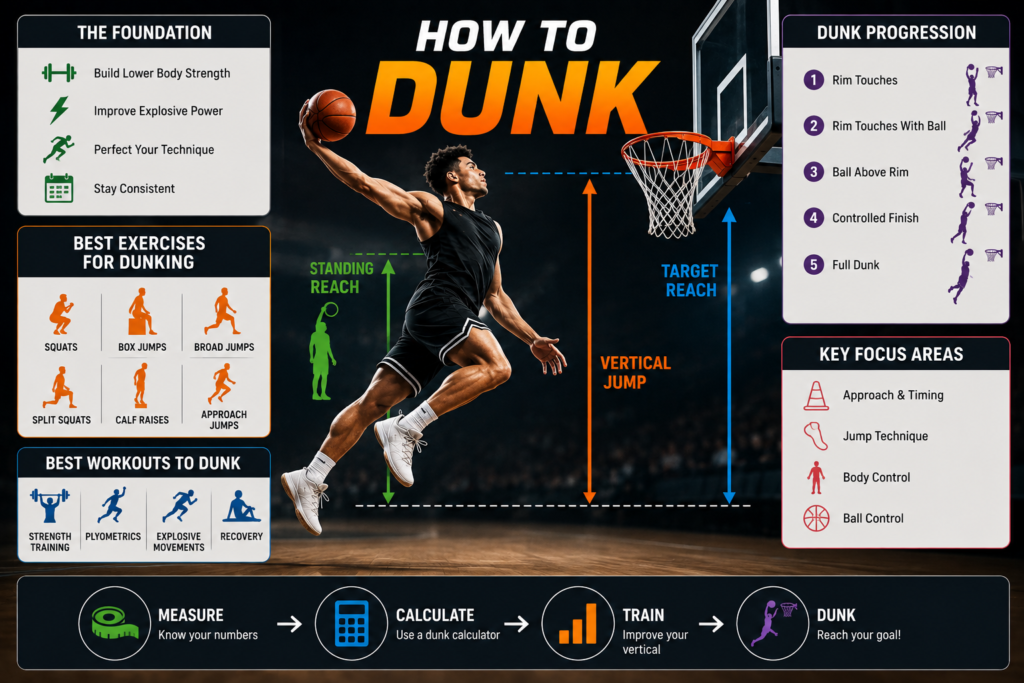
Best Exercises for Dunking
The best exercises for dunking should help develop strength, explosiveness, and jumping ability.
Some useful exercises include:
Squats
Squats can help develop lower-body strength, particularly in the muscles involved in jumping.
Focus on controlled movement and good technique rather than simply trying to lift as much weight as possible.
Bulgarian Split Squats
Single-leg exercises can help develop strength and stability while requiring each leg to work independently.
They can also be useful for athletes who want to improve their ability to produce force from one leg.
Calf Raises
Your calves contribute to the final part of the jumping movement. Calf raises can be included as part of a balanced lower-body strength routine.
Box Jumps
Box jumps allow you to practice explosive movement without needing to jump as high as you would when attempting a maximum dunk.
Focus on controlled landings and quality repetitions.
Broad Jumps
Broad jumps train explosive force while moving horizontally. They can also help you learn how to coordinate your arms, hips, and legs during an explosive movement.
Approach Jumps
Approach jumps are especially relevant for basketball players because many dunks happen after a running approach.
Practice your approach gradually and focus on consistent takeoff mechanics.
Best Workouts to Dunk
The best workouts to dunk are not necessarily the workouts with the most exercises. Quality and consistency are more important.
A simple training session could include:
Strength
- Squats
- Bulgarian split squats
- Calf raises
Explosive work
- Box jumps
- Broad jumps
- Approach jumps
Basketball skill
- Rim touches
- One-hand ball control
- Approach and takeoff practice
You do not need to perform every exercise in every session. Give your body enough recovery between demanding jumping sessions, especially when practicing maximum-effort jumps.
If you are new to strength training or plyometrics, start with easier variations and focus on technique before increasing intensity.
Dunk Training: Practice Your Jump Technique
Strength is only one part of dunking.
Your jump technique can have a major effect on how efficiently you use the strength and power you already have.
When practicing your jump, pay attention to:
- Your approach speed
- Your final steps
- Arm swing
- Takeoff position
- Body coordination
- Landing mechanics
Try to make your approach consistent. If your last few steps change every time, it can be difficult to determine whether your jumping ability is actually improving.
Start with controlled approach jumps and gradually increase your effort as your technique becomes more comfortable.
How to Dunk With a Running Approach
Many players find it easier to jump higher with an approach than from a stationary position.
When learning how to dunk, experiment with both one-foot and two-foot takeoffs to see which feels more natural for you.
A basic approach progression is:
Approach → Final steps → Takeoff → Reach → Finish → Controlled landing
Do not rush directly into maximum-effort dunks. First become comfortable reaching the rim consistently.
Once you can touch the rim reliably, you can begin practicing with a basketball and work toward controlling the ball at the highest point of your jump.
How to Slam Dunk for the First Time
Learning how to slam dunk is usually easier when you break the movement into stages.
Start by practicing rim touches without a basketball.
Next, practice jumping while holding a small object or basketball with two hands if you are comfortable doing so.
Then work toward a one-hand finish if you can comfortably control the ball while jumping.
Your progression might look like:
Rim touch → Rim touch with ball → Ball above rim → Controlled finish → Full dunk
This allows you to improve your jumping and ball control at the same time.
Do not worry if your first attempts are not successful. Missing the rim or losing control of the ball is part of learning the movement.
How Can You Dunk Higher?
If you can already reach the rim but cannot complete a dunk, you may only need a few additional inches of effective reach.
Continue working on your strength and explosive training while also improving your approach and takeoff technique.
Tracking your vertical jump can help you see whether your training is working.
For example:
Current vertical: 28 inches
Required vertical: 32 inches
Gap: 4 inches
Now you have a specific target instead of simply trying to “jump higher.”
Your progress should be measured over time rather than from one training session to another.
How Long Does It Take to Learn to Dunk?
There is no fixed timeline for learning to dunk.
The time required depends on your current vertical, strength, body proportions, jumping technique, training experience, and consistency.
Someone who is already close to the rim may need only a few additional inches, while another player may need a much larger improvement.
Instead of focusing on a specific number of weeks, track measurable progress such as:
- Vertical jump
- Rim touches
- Jump consistency
- Approach technique
- Ball control
- Dunk attempts
These measurements can give you a clearer picture of your progress.
Final Thoughts
Learning how to dunk is a combination of jumping ability, strength, technique, coordination, and practice.
Start by finding out how much vertical you actually need. Then build your training around closing the gap between your current vertical and your target.
Strength exercises can help you develop a stronger foundation, while plyometric exercises and approach jumps can help you practice explosive movement.
Most importantly, be patient and consistent. Your first dunk may take time, but having a specific target makes the process much easier to track.