A Share Incentive Plan (SIP) can give employees a tax-efficient way to receive or buy shares in the company they work for. However, the tax benefits depend on the type of shares, how long you keep them in the plan, and what happens when you eventually take them out.
For many employees, understanding the tax side of an SIP is just as important as understanding how the scheme works. The rules can seem complicated at first, especially when you consider Income Tax, National Insurance and Capital Gains Tax.
This guide explains the main Share Incentive Plan tax benefits in straightforward terms, with practical examples to help you understand how they can affect the potential value of your employee shares.
Reviewed: August 2026
Information source: Current GOV.UK and HMRC guidance. Tax rules can change, so check the latest official guidance and your employer’s SIP documentation before making a financial decision.
What Are the Main Share Incentive Plan Tax Benefits?
A Share Incentive Plan can offer several tax advantages that ordinary employee share purchases may not provide.
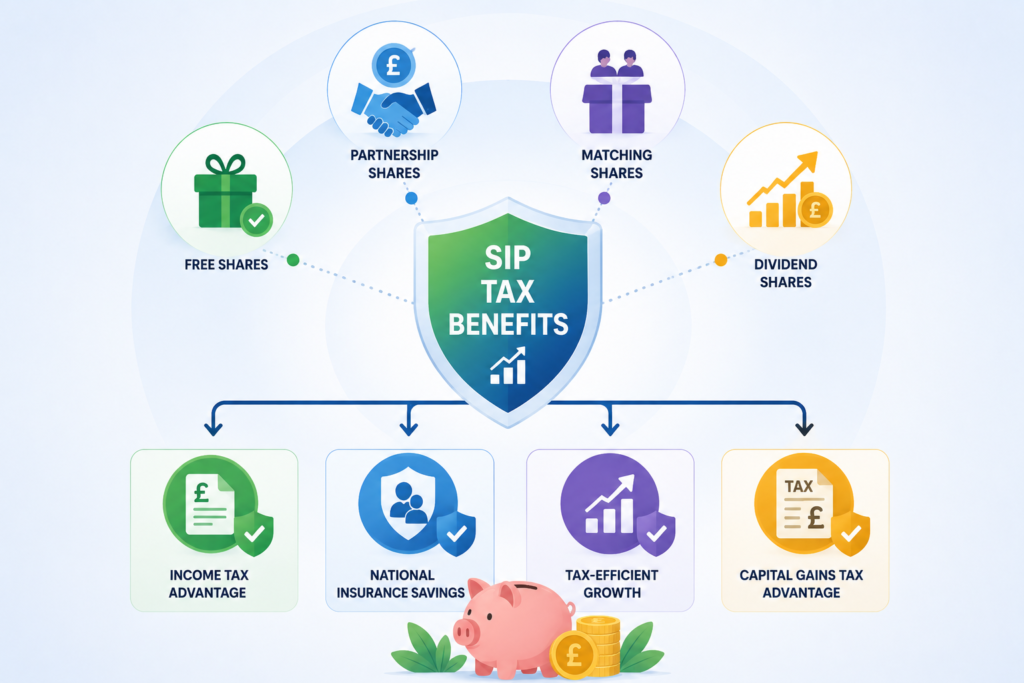
The main benefits can include:
- Potential Income Tax advantages
- Potential National Insurance savings
- Tax-efficient purchase of partnership shares
- Favourable treatment when qualifying shares remain in the plan
- Potential Capital Gains Tax advantages when shares stay in the plan until sale
GOV.UK currently confirms that employees who receive shares through an SIP and keep them in the plan for five years do not pay Income Tax or National Insurance on their value.
However, this does not mean every SIP share is automatically tax-free in every situation. The timing and reason for removing shares can change the tax treatment.
How Do SIP Tax Benefits Work?
A UK Share Incentive Plan can include four types of shares:
- Free shares
- Partnership shares
- Matching shares
- Dividend shares
Your employer does not have to offer all four types. The available options depend on the company’s SIP rules.
Each type can have a different tax treatment, so it helps to understand them separately.
Free Shares and Their Tax Treatment
Free shares are shares your employer gives you through the SIP.
Under current rules, an employer can award up to £3,600 of free shares per tax year to an employee.
Normally, receiving shares from an employer could create a taxable employment benefit. An approved SIP provides special tax treatment instead.
You do not normally pay Income Tax or National Insurance when qualifying free shares enter the plan. However, taking the shares out before the relevant holding period can affect the amount of tax and National Insurance you ultimately pay.
This is why the holding period matters when considering the overall benefit.
Partnership Shares Can Use Pre-Tax Salary
Partnership shares work differently from free shares.
You buy partnership shares using deductions from your salary. Under current rules, you can use up to the lower of £1,800 per tax year or 10% of your salary for this purpose.
One of the key SIP tax benefits is that qualifying partnership share purchases come from salary before Income Tax and National Insurance deductions.
For example, suppose you decide to contribute part of your salary to purchase partnership shares. Instead of receiving that amount as normal take-home pay and then buying shares, the SIP can deduct the qualifying amount before those taxes and contributions apply.
That can make partnership shares more tax-efficient than buying the same shares from your post-tax income.
Matching Shares Can Increase the Potential Benefit
Matching shares can make an SIP particularly valuable.
When you buy partnership shares, your employer may provide additional matching shares. The current statutory limit allows up to two matching shares for each partnership share purchased, although your employer’s plan may offer a lower ratio.
For example:
You buy: 100 partnership shares
Employer matching: 1-for-1
Total: 200 shares
The extra shares can increase your potential employee shareholding without requiring the same level of personal contribution.
Of course, shares can rise or fall in value. Matching shares therefore increase the number of shares you own, but they do not guarantee a profit.
If you want to explore how contributions and matching shares could affect your potential SIP value, you can use our Share Incentive Plan Calculator.
What Happens to SIP Shares After Five Years?
The five-year period is important when looking at Share Incentive Plan tax advantages.
If qualifying shares remain in the plan for five years, GOV.UK states that you will not pay Income Tax or National Insurance on their value.
Earlier withdrawal can produce a different result. The amount of tax and National Insurance due can depend on the type of share, how long you held it and why you removed it from the plan. HMRC explains that the longer qualifying shares remain in the SIP, the greater the available tax advantage.
So, if you are thinking about withdrawing your shares, do not look only at their current market value. Consider the potential tax consequences too.
Are SIP Shares Free From Capital Gains Tax?
Capital Gains Tax (CGT) works differently from Income Tax and National Insurance.
If you keep your SIP shares in the plan until you sell them, GOV.UK says you will not pay Capital Gains Tax on the gains from that sale.
You can also transfer qualifying shares to an ISA within 90 days of taking them out of the plan without paying Capital Gains Tax on the transfer, subject to the applicable rules.
However, removing shares from the SIP before selling them can change the CGT position. HMRC treats shares that cease to be subject to the plan in a specific way when calculating later gains.
This makes it important to understand the difference between SIP tax treatment and the normal tax treatment of shares held outside the scheme.
What About Dividend Shares?
Some SIPs allow employees to use dividends from their plan shares to buy additional shares.
These are known as dividend shares. If the scheme provides this option, you can reinvest dividends into additional company shares instead of taking the dividend as cash.
Current HMRC guidance states that employees do not pay Income Tax on qualifying dividend shares when they keep those shares in the plan for at least three years.
Not every employer offers dividend shares, so check your scheme rules before assuming this option is available.
How Much Could Your SIP Tax Benefits Be Worth?
The potential value of your SIP depends on more than tax alone.
Your calculation may include:
- Your partnership share contributions
- The number of free shares you receive
- Employer matching shares
- Dividend shares
- Current share price
- Changes in share price
- How long you hold the shares
- The tax treatment when you remove or sell them
For example, two employees could contribute the same amount but end up with different results if their employers offer different matching arrangements.
This is where a Share Incentive Plan Calculator can help. You can use our Share Incentive Plan Calculator to explore different contribution, matching and share-price scenarios and get an estimate of the potential value.
The calculator should be treated as a planning tool rather than a guarantee of future returns or personal tax advice.
What Happens If You Leave Your Employer?
Leaving your job can affect your SIP tax treatment.
The outcome depends partly on why you leave and how long your shares have remained in the plan. Certain circumstances, such as retirement, redundancy or disability, can receive different treatment from a voluntary resignation.
Before taking your shares out, check your employer’s scheme documents and the latest HMRC guidance.
If a significant amount of money is involved, professional tax advice can also help you understand the consequences for your individual situation.
How We Approach SIP Tax Calculations
A useful SIP calculation should not focus only on the current share price.
Instead, consider the full picture: your contributions, employer matching, share awards, holding period and potential tax treatment.
That is also why it helps to compare more than one scenario. For example, you could calculate the potential value of your plan with a 1-for-1 employer match and then compare it with a scenario where the employer offers 2 matching shares for each partnership share.
Our Share Incentive Plan Calculator can help you compare these types of scenarios. The result is an estimate, because future share prices and individual tax circumstances can change.
Final Thoughts on Share Incentive Plan Tax Benefits
The main Share Incentive Plan tax benefits come from the special treatment available to qualifying SIP shares.
Partnership shares can use pre-tax and pre-National Insurance salary within the applicable limits. Free and matching shares can receive favourable tax treatment, while qualifying shares kept in the plan for five years can benefit from full Income Tax and National Insurance advantages. SIPs can also provide valuable Capital Gains Tax advantages in certain circumstances.
However, tax treatment depends on your circumstances, the type of shares and the timing of any withdrawal.
If you are new to SIPs, start with our guide What Is a Share Incentive Plan? A Complete Guide for Employees. You can then learn more about the practical process in How Does a Share Incentive Plan Work?.
Once you understand the basics, use our Share Incentive Plan Calculator to explore the potential value of your contributions and employee shares.
This article provides general information, not personal tax or financial advice. Always check your employer’s SIP rules and current GOV.UK/HMRC guidance before making decisions about your shares.
Frequently Asked Questions
Are Share Incentive Plans tax-free?
SIPs can provide significant tax advantages, but the exact treatment depends on the type of shares, holding period and circumstances. Keeping qualifying shares in the plan for five years can provide full Income Tax and National Insurance advantages.
What is the biggest tax benefit of an SIP?
One of the main benefits is the ability to receive or purchase qualifying shares with favourable Income Tax and National Insurance treatment. The five-year holding period can also provide important tax advantages.
Do you pay Capital Gains Tax on SIP shares?
If you keep your SIP shares in the plan until you sell them, GOV.UK says you will not pay Capital Gains Tax on the gains from that sale. Different rules can apply if you remove the shares before selling them.
Can a Share Incentive Plan reduce National Insurance?
Yes. Qualifying SIP arrangements can provide National Insurance advantages. For example, partnership shares can be purchased from salary before Income Tax and National Insurance deductions, subject to the applicable rules.
Should I use a SIP calculator before joining a plan?
A calculator can help you understand potential outcomes by comparing contributions, employer matching and share prices. It should support your decision-making rather than replace tax or financial advice.