
Dunking a basketball is not only about being tall. Your standing reach, vertical jump, rim height, and jumping technique all affect how easily you can reach the rim and finish a dunk.
The Dunk Calculator helps turn these measurements into a simple target. Instead of wondering how much you need to jump, you can use your own standing reach and target height to estimate the vertical jump required to dunk.
Whether you are working toward your first dunk, trying to improve your jump, or simply curious about your dunking potential, understanding the numbers can help you set a more realistic goal.
What Is the Dunk Calculator?
The Dunk Calculator is an online tool that estimates the vertical jump you need to reach a specific dunking target.
A standard basketball rim is 10 feet high, but reaching the rim is not necessarily enough to dunk. You generally need additional reach above the rim to control the ball and complete the dunk.
The calculator uses measurements such as:
- Player height
- Standing reach
- Rim height
- Clearance above the rim
- Current vertical jump
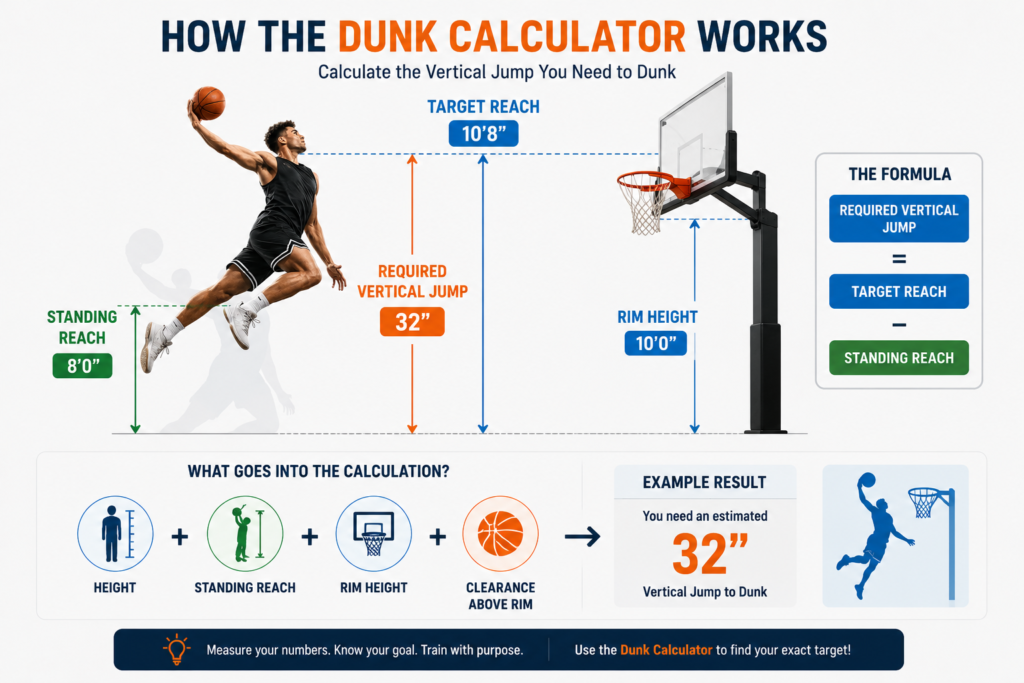
The basic calculation is:
Required Vertical Jump = Target Reach − Standing Reach
Your target reach is based on the rim height plus the clearance you want.
For example, if your target is 10 feet 8 inches and your standing reach is 8 feet, the required vertical is:
10’8″ − 8’0″ = 32 inches
This gives you a practical number to work toward.
How Does a Dunk Height Calculator Work?
A dunk height calculator works by finding the difference between how high you need to reach and how high you can already reach while standing.
First, determine the rim height. A standard basketball rim is:
10 feet = 120 inches
Next, decide how much clearance you want above the rim. For example, you might use 8 inches as an example target.
That gives you:
120 + 8 = 128 inches
If your standing reach is 96 inches:
128 − 96 = 32 inches
Your estimated required vertical jump would therefore be 32 inches.
The calculation becomes more useful when you enter your actual standing reach instead of estimating it from your height.
Why Standing Reach Matters for Dunking
Height is useful, but standing reach is often more important when calculating the vertical needed to dunk.
Standing reach is the highest point you can touch with one hand while standing flat-footed. Two players can have the same height but different arm lengths and different standing reaches.
Imagine two players who are both 6 feet tall. If one player has a higher standing reach, that player may need less vertical jump to reach the same dunking target.
This is why a good vert calculator should use your standing reach rather than relying only on height.
How to Measure Standing Reach
You can measure your standing reach at home with a wall and a measuring tape.
- Stand flat-footed next to a wall.
- Reach upward with one hand as high as possible.
- Keep your heels on the floor.
- Mark the highest point you can reach.
- Measure from the floor to the mark.
Measure more than once if possible and use a consistent method.
An accurate standing reach measurement can make your calculated dunk target much more useful.
How Much Vertical Do You Need to Dunk?
There is no single vertical jump number that guarantees a dunk for every player.
A player with a high standing reach may be able to dunk with a lower vertical than a player with a lower standing reach.
For example, using a 10-foot rim and 8 inches of clearance:
| Standing Reach | Required Vertical |
|---|---|
| 7’4″ | 40 inches |
| 7’6″ | 38 inches |
| 7’8″ | 36 inches |
| 8’0″ | 32 inches |
| 8’2″ | 30 inches |
| 8’4″ | 28 inches |
These are example calculations rather than universal requirements. Your actual standing reach and the type of dunk you are attempting can change the number.
This is why comparing your vertical with another player’s number does not always tell you whether you can dunk.
How High Do I Need to Jump to Dunk?
To find out how high you need to jump to dunk, you need two main measurements:
Your standing reach and your target reach.
For a standard 10-foot rim, the target reach is usually higher than 10 feet because you need enough clearance to control the ball above the rim.
For example:
Standing reach: 8’0″
Rim height: 10’0″
Clearance: 8″
Target reach: 10’8″
Required vertical: 32″
This means the player would need an estimated 32-inch vertical to reach that particular target.
If you want to calculate your own numbers, use the Dunk Calculator with your actual standing reach, rim height, clearance, and current vertical.
How Much of a Vertical Do I Need to Dunk at 6 Feet?
Being 6 feet tall does not automatically mean you need a specific vertical.
The answer depends on your standing reach.
A 6-foot player with a longer standing reach may need less vertical than another 6-foot player with a shorter standing reach.
For example, if a 6-foot player has an 8-foot standing reach and wants to reach 10 feet 8 inches:
10’8″ − 8’0″ = 32 inches
So the estimated target would be a 32-inch vertical jump.
This example shows why height alone is not enough to determine your dunking vertical.
How Tall Do You Have to Be to Dunk?
You do not have to be a specific height to dunk.
Taller players often have an advantage because they tend to have a higher standing reach, but shorter players can also dunk if they can generate enough vertical jump.
Instead of asking only, “How tall do you need to be to dunk?”, it is more useful to ask:
How high can you reach when you jump?
Your maximum reach is influenced by your standing reach and vertical jump.
For example:
Standing Reach + Vertical Jump = Maximum Jumping Reach
This is why a shorter player with an excellent vertical can dunk, while a taller player with a lower vertical may not be able to.
Can You Dunk With a 30-Inch Vertical?
A 30-inch vertical can be enough to dunk for some players.
Whether it is enough depends on your standing reach and your target clearance.
For example, a player with an 8’2″ standing reach and a 10’8″ target reach would need:
10’8″ − 8’2″ = 30 inches
In that example, a 30-inch vertical reaches the target.
Another player with a 7’8″ standing reach would need a higher vertical to reach the same target.
So rather than asking whether a 30-inch vertical is automatically enough, compare your current vertical with your personal required vertical.
What Vertical Do I Need to Dunk?
Your required vertical depends on the difference between your standing reach and your target reach.
The formula is:
Required Vertical = Target Reach − Standing Reach
Your target reach can change depending on:
- Rim height
- Desired clearance
- Dunking technique
- Your ability to control the ball
- Whether you use a running or standing jump
This means the best way to determine your vertical to dunk is to use your own measurements instead of relying on a general number.
Running Dunk Jump vs. Standing Jump
Your dunk jump may be different from your standing vertical.
A standing jump starts from a stationary position. A running or approach jump allows you to use momentum from your approach, which can help you jump higher.
Many basketball players use an approach when attempting a dunk during a game.
For this reason, your training should consider the type of jump you actually use when dunking. A player who can jump higher with an approach may have a different dunking ability from the same player jumping from a standstill.
How Can You Jump Higher to Dunk?
If your required vertical is higher than your current vertical, you can use the difference as a training target.
Improving your dunk jump can involve:
- Lower-body strength training
- Plyometric exercises
- Explosive movements
- Sprint and acceleration work
- Jump technique
- Mobility
- Proper recovery
The goal is not simply to jump every day. Your muscles and joints need recovery, and your training should match your current experience and fitness level.
Tracking your vertical over time can also help you see whether your training is producing progress.
How to Use the Dunk Calculator
The easiest way to find your personal dunking target is to use your actual measurements.
Enter your:
- Player height
- Standing reach
- Rim height
- Desired clearance
- Current vertical jump, if you know it
The calculator uses these values to estimate your required vertical jump.
Suggested sentence:
Ready to calculate your own dunking target? Use our Dunk Calculator to find your required vertical based on your standing reach, rim height, and desired clearance.
This should be the main contextual internal link from this article to your calculator page.
Understanding Your Dunking Number
Once you know your required vertical, compare it with your current vertical.
For example:
Required vertical: 34 inches
Current vertical: 28 inches
Estimated gap: 6 inches
The 6-inch difference gives you a measurable target.
Instead of simply saying that you want to “jump higher,” you can work toward a specific number and track your progress over time.
Keep in mind that a calculator provides an estimate. Actual dunking ability also depends on timing, coordination, jumping technique, approach, ball control, and the type of dunk you are attempting.
Final Thoughts
The Dunk Calculator makes it easier to understand the numbers behind dunking.
There is no single vertical jump that every player needs. Your standing reach, rim height, target clearance, and jumping ability all affect how high you need to jump.
A player at 6 feet may need a different vertical from another 6-foot player, while a shorter player can still dunk with enough explosive jumping ability.
The most useful approach is to measure your standing reach, calculate your target reach, and compare the required vertical with your current vertical.
Once you know your number, you have a much clearer goal to work toward.
Use the Dunk Calculator to calculate your required vertical jump and find out how close you are to your dunking target.