If you are new to employee share schemes, you may wonder, how does a Share Incentive Plan work? A Share Incentive Plan (SIP) gives employees a way to receive or buy shares in the company they work for.
Depending on the employer’s scheme, employees can receive free shares, buy partnership shares from their salary, receive matching shares, or reinvest dividends into additional shares.
The main benefit is that an SIP can combine employee ownership with potential tax advantages. However, the exact benefits depend on the type of shares, the plan rules and how long you keep the shares in the scheme.
If you first want to understand the basic definition, read our guide on What Is a Share Incentive Plan? before exploring how the scheme works in practice.
How Does a Share Incentive Plan Work Step by Step?
A Share Incentive Plan usually follows a simple process.
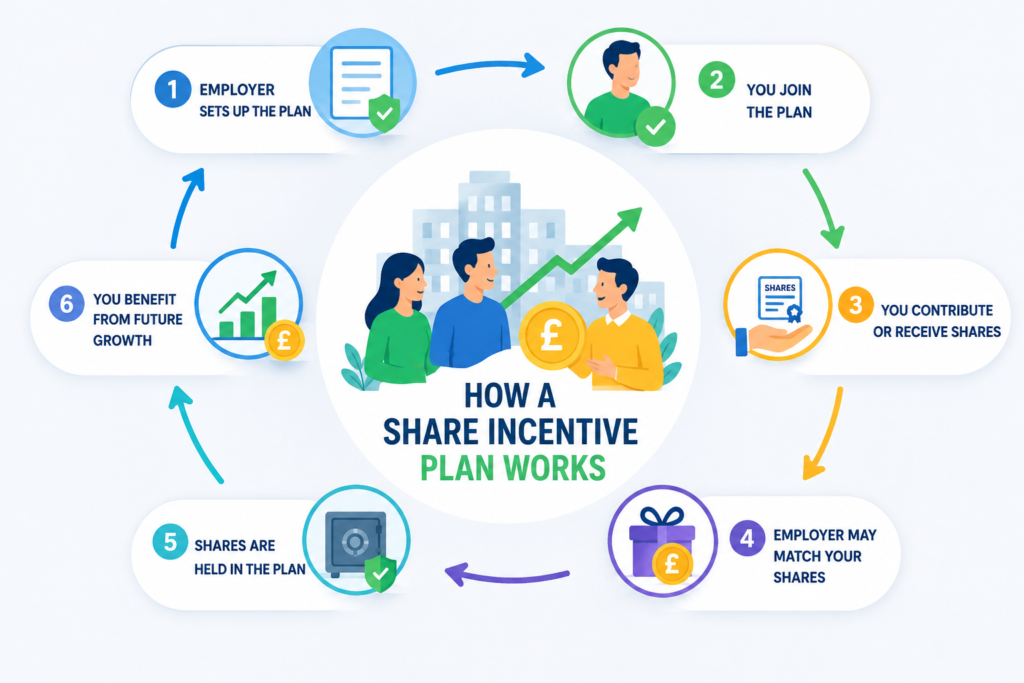
First, your employer sets up the scheme and decides which types of SIP shares it will offer. Next, eligible employees can join the plan according to the employer’s rules.
You may then receive shares, buy shares from your salary, or receive additional shares from your employer. The shares normally stay within the plan until you meet the relevant conditions for taking them out.
Here is a simple overview:
- Your employer offers an SIP
- You join the plan if you are eligible
- You receive or buy shares
- Your employer may provide matching shares
- You hold the shares in the plan
- You can eventually take the shares out, subject to the plan rules
The exact process can vary between employers, so always check the terms of your own Share Incentive Plan.
What Types of Shares Can You Get Through an SIP?
A UK Share Incentive Plan can include four main types of shares: free shares, partnership shares, matching shares and dividend shares. Employers can choose which types their scheme offers.
Free Shares
Free shares are shares that your employer awards to you without requiring you to buy them.
An employer may use free shares as part of its employee benefits package. Some schemes can also link free share awards to factors such as company, team or individual performance.
The value and conditions of free shares depend on the scheme rules.
Partnership Shares
Partnership shares work differently. You buy these shares using deductions from your salary.
One advantage is that you can buy partnership shares from your gross pay under the SIP rules. This can provide Income Tax and National Insurance advantages compared with buying shares from your normal take-home pay.
Your employer will explain how much you can contribute and how the deductions work.
Matching Shares
Matching shares can make an SIP particularly attractive.
When you buy partnership shares, your employer may give you additional shares as a reward. The matching ratio depends on your employer’s scheme. Under the current SIP rules, an employer can provide up to two matching shares for each partnership share you buy.
For example, if your employer offers a 1:1 match and you buy 100 partnership shares, you could receive another 100 matching shares.
Some employers may offer a different matching structure, so check your plan before estimating the value of your shares.
Dividend Shares
You may also receive dividends from shares already held in your SIP.
If your employer’s scheme allows it, you can use those dividends to buy additional shares. These are known as dividend shares.
This approach can help you gradually increase the number of shares you hold without making additional salary contributions.
How Are SIP Shares Held?
A Share Incentive Plan normally holds your shares through a plan trust.
The trust structure allows the scheme to hold the shares on your behalf while you remain part of the plan. Your shares can stay in the plan for the required holding period before you take them out.
This holding period matters because it can affect the tax treatment of your shares.
For example, free and matching shares generally have to remain in the plan for a minimum period. Your employer can set certain holding periods within the rules of the scheme.
How Long Do SIP Shares Stay in the Plan?
The holding period depends on the type of shares and the rules of your employer’s scheme.
Partnership shares can generally be taken out of the plan at any time, but removing them early can affect the tax treatment and, in some cases, your matching shares.
Free and matching shares cannot normally come out during the first three years. Employers can extend the holding period for these shares up to five years. Dividend shares have their own holding period rules.
Therefore, do not assume that every SIP follows exactly the same timeline. Your employer’s plan documents should explain the specific conditions.
What Are the Tax Benefits of a Share Incentive Plan?
Tax advantages are one of the main reasons employees consider SIPs.
Under the relevant rules, employees can receive certain shares through an SIP without paying Income Tax and National Insurance on their value when they acquire them. The tax treatment can also depend on how long the shares stay in the plan.
If you keep qualifying shares in the plan for the required period, you can generally receive greater tax advantages.
However, taking shares out early can create tax or National Insurance charges in some circumstances. The reason for removing the shares and the length of time they have remained in the plan can affect the outcome.
For that reason, check the current rules before making a decision about withdrawing your shares.
How Does Employer Matching Affect Your SIP?
Employer matching can have a significant effect on your potential SIP value.
Imagine that you buy 50 partnership shares and your employer matches each share with one additional share. You would then have 100 shares in total.
If the employer offered two matching shares for every partnership share, your 50 purchased shares could result in another 100 matching shares. That would give you 150 shares altogether.
The actual value will still depend on the company’s share price and the rules of your plan.
If you want to explore different contribution and matching scenarios, use our Share Incentive Plan Calculator to estimate the potential value.
What Happens to Your SIP If You Leave Your Job?
Leaving your employer can affect your Share Incentive Plan.
If you leave your job, the shares normally have to come out of the plan. The tax treatment can depend on why you left and how long you held the shares.
Certain reasons for leaving, such as retirement, redundancy, disability or the sale of part of the business, can receive different treatment under the rules.
Because the outcome can vary, check your employer’s SIP documents before leaving or withdrawing shares.
How Can You Calculate the Potential Value of an SIP?
Once you understand how a Share Incentive Plan works, you can start looking at the numbers.
The potential value of your SIP can depend on several factors, including:
- Your employee contributions
- The number of partnership shares you buy
- Employer matching
- Free share awards
- Dividend shares
- The current share price
- Future changes in share price
- The length of time you hold the shares
For example, a higher employer matching ratio could increase the number of shares you receive. Similarly, a change in the company’s share price can increase or decrease the market value of your holdings.
Our Share Incentive Plan Calculator lets you explore these factors in one place. You can enter your figures and compare different scenarios to get an estimate of the potential value of your employee shares.
Remember that the calculator provides an estimate. Share prices can change, and your employer’s scheme rules may affect the final result.
Is a Share Incentive Plan Worth Considering?
An SIP can offer several potential benefits for employees.
You may receive shares from your employer, buy shares using gross salary, receive matching shares, or reinvest dividends. At the same time, the scheme can provide tax advantages when you meet the relevant conditions.
However, employee shares also carry risk. If the company’s share price falls, the market value of your shares can fall too.
Therefore, consider both the potential benefits and the risks before deciding how much to contribute.
Final Thoughts
So, how does a Share Incentive Plan work? In simple terms, an SIP gives employees a structured way to receive or buy shares in their employer. The scheme can then provide additional benefits through employer matching, dividend reinvestment and potential tax advantages.
The four main types of SIP shares are free shares, partnership shares, matching shares and dividend shares. Your employer decides which options the scheme provides and sets the relevant conditions within the applicable rules.
If you want to learn the basics first, read our What Is a Share Incentive Plan? A Complete Guide for Employees. Then, when you are ready to estimate your potential share value, try our Share Incentive Plan Calculator.
Always check your employer’s scheme documentation and current official guidance before making financial or tax decisions.
Frequently Asked Questions
How does a Share Incentive Plan work?
A Share Incentive Plan allows eligible employees to receive or buy shares in their employer. Depending on the scheme, employees can receive free shares, buy partnership shares, receive matching shares or reinvest dividends into additional shares.
What are the four types of SIP shares?
The four main types are free shares, partnership shares, matching shares and dividend shares. An employer does not have to offer every type.
Do employers have to match SIP shares?
No. Matching shares are optional. If your employer offers them, the matching ratio and conditions will appear in the company’s SIP rules.
Can I calculate the value of my SIP?
Yes. A Share Incentive Plan Calculator can help you estimate potential value using factors such as contributions, matching shares and share price.
Are SIP shares tax-free?
SIP shares can receive favourable tax treatment when you meet the relevant conditions. The exact treatment depends on the type of shares, holding period and circumstances.