If you have ever wondered what is a Share Incentive Plan, you are not alone. A Share Incentive Plan (SIP) is a UK employee share scheme that allows employees to receive or buy shares in the company they work for. Depending on the type of shares and the rules of the scheme, employees can potentially benefit from tax advantages while building an ownership stake in their employer.
A Share Incentive Plan can include free shares, partnership shares, matching shares and dividend shares. Understanding how each type works can help you decide whether an SIP could be a useful part of your employee benefits package.
If you already have access to an SIP and want to estimate the potential value of your shares, you can also use our Share Incentive Plan Calculator to explore different contribution, share price and employer matching scenarios.
What Is a Share Incentive Plan?
A Share Incentive Plan (SIP) is an employee share ownership scheme that allows participating employees to hold shares in their employer in a tax-efficient way, subject to the relevant rules and conditions.
Employers can use SIPs to encourage employee ownership and give staff a direct financial interest in the performance of the business. Employees may receive shares from their employer, purchase shares from their salary, or receive additional shares based on their own contributions.
The exact benefits depend on the type of SIP, the number of shares involved, the company’s share price and how long the shares remain in the plan.
For employees, an SIP can therefore provide more than just another workplace benefit. It can give you an opportunity to build a shareholding in the company while potentially receiving favourable tax treatment.
How Does a Share Incentive Plan Work?
A Share Incentive Plan can work in several different ways. The employer decides which types of shares the scheme offers and sets the relevant plan rules within the limits of the legislation.
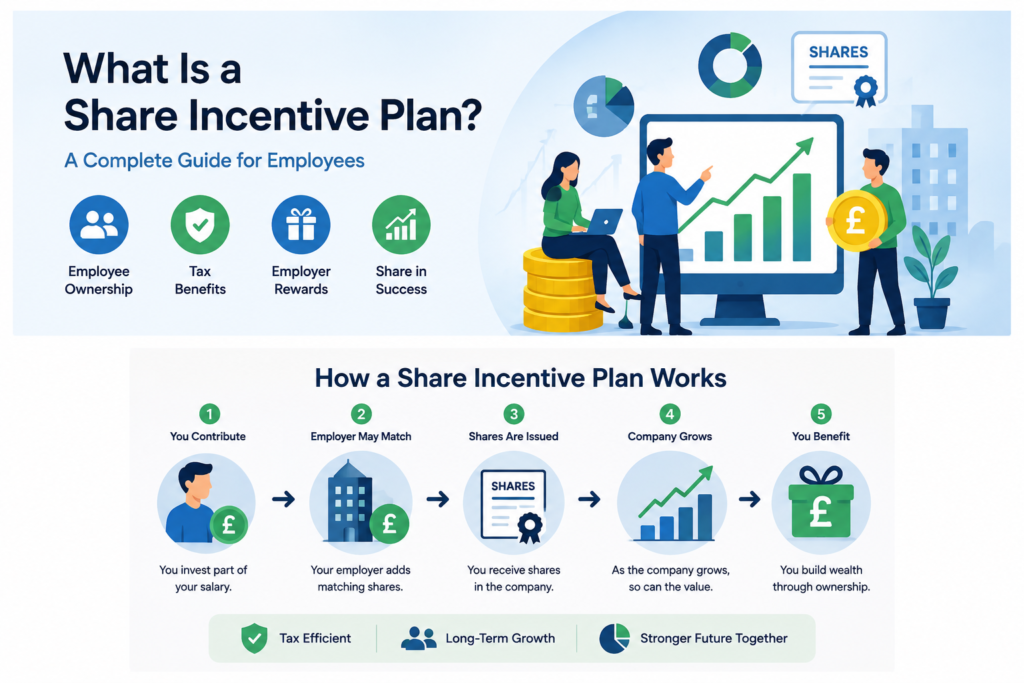
Employees may receive free shares, buy partnership shares from their salary, receive matching shares from their employer, or use dividends to acquire additional shares.
For example, imagine an employee buys partnership shares through the SIP and the employer provides matching shares. The employee could then own more shares than they purchased personally. If the company’s share price increases, the value of those shares could also increase.
The potential value will depend on several factors, so it can be useful to test different figures with a Share Incentive Plan Calculator.
What Are the Different Types of SIP Shares?
A Share Incentive Plan can include four main types of shares.
Free Shares
Employers can give employees free shares as part of the SIP. The number of free shares an employee receives depends on the employer’s scheme and the applicable rules.
Free shares can provide employees with an ownership interest without requiring them to purchase the shares directly.
Partnership Shares
Partnership shares allow employees to buy shares using deductions from their salary. This gives employees a way to invest in their employer through the SIP.
The amount an employee can contribute depends on the applicable SIP limits and the employer’s scheme rules.
Matching Shares
Matching shares are additional shares that an employer can provide when an employee buys partnership shares. The employer may offer matching shares according to a set ratio, subject to the relevant rules.
For example, an employer might offer one matching share for every partnership share purchased. Some schemes may offer a higher matching ratio.
Because matching shares can significantly affect the potential value of an SIP, employees may want to compare different scenarios using a Share Incentive Plan Calculator.
Dividend Shares
Dividend shares allow employees to use dividends from SIP shares to acquire additional shares, where the scheme provides this option.
Instead of receiving the dividend as cash, the employee can potentially build their shareholding by reinvesting it into additional company shares.
What Are the Tax Benefits of a Share Incentive Plan?
One of the main reasons employees consider a Share Incentive Plan is the potential tax benefits.
The tax treatment depends on factors such as the type of shares, how you acquire them and how long you keep them within the plan. Keeping qualifying SIP shares in the plan for the required period can provide favourable Income Tax and National Insurance treatment.
However, tax rules can change, and individual circumstances can affect the outcome. Employees should therefore check the current rules and their employer’s specific SIP terms before making financial decisions.
A Share Incentive Plan Calculator can help you estimate potential share values, but it should not replace professional tax or financial advice.
How Much Can You Invest in a Share Incentive Plan?
The amount you can invest depends on the type of SIP shares and the rules that apply to the scheme.
Partnership shares, for example, use deductions from your salary. Free shares and matching shares work differently because the employer provides the shares rather than requiring the employee to purchase them directly.
When calculating the potential value of your SIP, consider your contribution alongside any employer matching. Even a relatively small regular contribution could result in a larger shareholding when employer matching applies.
You can use our [INTERNAL LINK → Share Incentive Plan Calculator] to see how different contribution and matching amounts could affect the estimated value.
How Long Do You Need to Keep SIP Shares?
The length of time you hold shares can affect the tax treatment of your Share Incentive Plan.
SIP rules include specific holding periods for different types of shares. Keeping shares in the plan for the required period can help you retain the available tax advantages.
Before withdrawing or transferring shares, check your employer’s SIP rules and understand how the decision could affect your tax position.
The holding period can also form an important part of your overall calculation. If you are estimating the potential value of your employee shares over several years, try different assumptions with a [INTERNAL LINK → Share Incentive Plan Calculator].
What Happens If You Leave Your Job?
What happens to your SIP shares when you leave your employer depends on the reason for leaving and the rules of your scheme.
In some circumstances, you may be able to keep your shares or transfer them out of the plan. In other situations, leaving before the end of a relevant holding period could affect the tax treatment of the shares.
Because the outcome can vary, always check your employer’s SIP documentation before leaving or transferring shares.
Understanding these rules can help you avoid unexpected tax consequences and make a more informed decision about your employee share ownership.
Is a Share Incentive Plan Worth It?
Whether a Share Incentive Plan is worthwhile depends on your circumstances, the employer’s scheme and the benefits available.
An SIP can be attractive when an employer provides matching shares because your contribution may result in additional shares. The potential tax advantages can also make an SIP an interesting employee benefit.
However, company shares can rise or fall in value. Your potential return therefore depends partly on the future performance of the company’s shares.
It is helpful to consider the potential benefits alongside the risks rather than assuming that the value of your shares will always increase.
How Can You Calculate the Potential Value of an SIP?
Calculating the potential value of a Share Incentive Plan involves looking at several variables, including your contributions, the number of shares, employer matching and the share price.
For example, if you contribute a certain amount each month and your employer provides matching shares, your total shareholding could grow faster than it would through your contributions alone.
You can use our Share Incentive Plan Calculator to enter your figures and explore different scenarios. Try changing the contribution amount, share price or matching level to see how each factor could influence the estimated value.
Remember that a calculator provides an estimate. Actual results can vary because share prices change and SIP rules, tax treatment and individual circumstances can affect the final outcome.
Final Thoughts on Share Incentive Plans
A Share Incentive Plan can give employees an opportunity to become shareholders in their employer while potentially benefiting from favourable tax treatment. The scheme can include free shares, partnership shares, matching shares and dividend shares, with each type offering a different way to build employee share ownership.
Understanding the rules, contribution limits, holding periods and potential tax benefits is important before deciding how to use an SIP.
If you already participate in a Share Incentive Plan, our Share Incentive Plan Calculator can help you estimate the potential value of your shares and compare different scenarios based on your contributions, employer matching and share price.
For the latest tax rules and the exact terms of your scheme, always check the information provided by your employer and the relevant official guidance.
Frequently Asked Questions
What is a Share Incentive Plan?
A Share Incentive Plan is a UK employee share scheme that allows employees to receive or purchase shares in their employer, subject to the scheme rules and applicable legislation.
Are Share Incentive Plans tax-free?
SIPs can offer tax advantages when employees meet the relevant conditions and holding periods. The exact treatment depends on the type of shares and individual circumstances.
Can I use a Share Incentive Plan Calculator to estimate my shares?
Yes. A Share Incentive Plan Calculator can help you estimate potential share value based on factors such as contributions, employer matching and share price.
What are matching shares?
Matching shares are additional shares that an employer may give an employee when they purchase partnership shares through a Share Incentive Plan. The matching ratio depends on the scheme and applicable rules.